
SCALP HEALTH 101: WHY HEALTHY HAIR STARTS AT THE SCALP
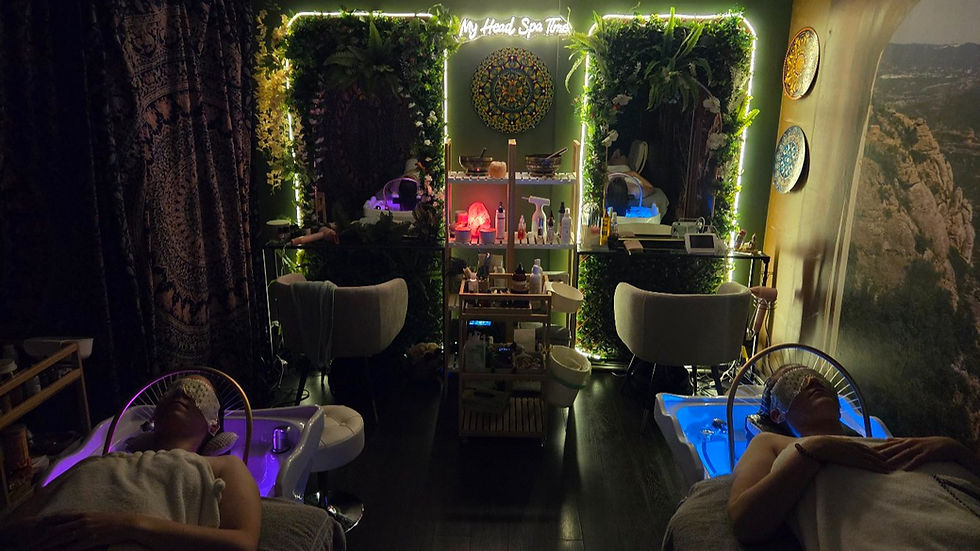
We spend a lot of time worrying about our hair. The shampoo, the conditioner, the masks, the styling tools, the trims. But the truth is: healthy hair doesn't begin at the ends. It begins at the scalp.
Your scalp is skin, and like the skin on your face, it has needs, a microbiome, a sensitivity, and a balance that can quietly be thrown off. The state of your scalp affects how your hair grows, how it looks, and how it feels. And most of us are paying it almost no attention.
Here's what you need to know about scalp health, what an unhappy scalp actually looks like, and how head spa treatments support a healthier scalp from the root up.
WHY SCALP HEALTH MATTERS
Your hair follicles live in your scalp. That means everything that affects the scalp — circulation, oil balance, buildup, inflammation, hydration — affects the way your hair grows out of it.
A healthy scalp supports:
- Stronger, more resilient hair growth
- Less breakage and shedding
- Less itchiness, dryness, or flakiness
- A more balanced oil cycle (less greasy by day two, less dry at the ends)
- A more vibrant, fuller-looking head of hair
- Less scalp tension and even fewer tension headaches
When the scalp is unhealthy, your hair pays for it. No matter how expensive your conditioner is.
WHAT AN UNBALANCED SCALP CAN LOOK LIKE
You don't have to have visible dandruff or hair loss to have an unbalanced scalp. Watch for:
- Oily roots within 24 hours of washing
- Persistent itchiness
- Tightness, sensitivity, or tenderness on the scalp
- Tiny flakes (sometimes mistaken for dry skin or product residue)
- Hair that feels limp, weighed down, or "coated"
- Increased shedding
- A persistent scalp odour even shortly after washing
- Tension that radiates from the crown or temples
These are all signs your scalp is asking for some care.
THE MOST COMMON CAUSES OF AN UNHEALTHY SCALP
Most scalp imbalance comes from a combination of:
Product buildup
Conditioners, dry shampoos, hairsprays, oils. They can collect at the root and trap dirt, sebum, and dead skin cells.
Hard water
Mineral buildup from hard water is one of the most underrated scalp culprits and can leave hair flat, dull, and the scalp irritated.
Over-washing or under-washing
Both extremes throw off the scalp's natural oil production.
Stress
A stressed nervous system shows up on the scalp through tension, dryness, and even hair shedding.
Heat styling and tight hairstyles
Repeated heat and tension can inflame the scalp over time.
Diet, hormones, and sleep
Your scalp reflects what's happening inside the rest of your body.
WHAT GOOD SCALP CARE LOOKS LIKE
Caring for your scalp doesn't have to be complicated, but it does need to be consistent. A few practical habits:
- Wash regularly with a sulfate-free shampoo. Aim for clean scalp, not stripped.
- Massage your scalp for two to three minutes a few times a week. Even with just your fingertips, this supports circulation.
- Don't pile conditioner on the roots. Focus from mid-length down.
- Avoid scratching aggressively. Massage instead.
- Drink water. A dehydrated body almost always means a dehydrated scalp.
- Manage stress. Your scalp is one of the first places your nervous system shows up.
- Get a professional scalp treatment regularly. This is where a head spa comes in.
HOW A HEAD SPA SUPPORTS LONG-TERM SCALP HEALTH
A head spa is one of the most thorough things you can do for your scalp. Each treatment combines several elements that together create a real reset:
Deep scalp cleansing
Detox treatments and warm water therapy gently lift product buildup, hard water minerals, oil, and pollution that regular shampooing can't fully remove.
Improved circulation
Acupressure and scalp massage stimulate blood flow, supporting follicle health and nutrient delivery.
Balanced oil production
Cleansing and nourishing oils help restore the scalp's natural rhythm, so it isn't constantly overproducing or feeling stripped.
Reduced tension and inflammation
Releasing tension in the scalp, neck, and shoulders eases some of the daily strain that contributes to chronic scalp tightness.
Nourishment from the right products
Natural, well-formulated scalp products penetrate more effectively when the scalp has been properly cleansed and warmed.
HOW OFTEN SHOULD YOU TREAT YOUR SCALP?
For scalp maintenance: every 4 to 6 weeks.
For scalp imbalance, flaking, or oiliness: every 2 to 3 weeks for a few cycles, then move to maintenance.
For seasonal resets (especially after summer sun and chlorine, or winter dryness): every change of season.
BOOK A SCALP-FOCUSED HEAD SPA IN KELOWNA
Healthier hair doesn't come from another bottle. It comes from a healthier scalp. If your scalp has been quietly asking for some attention, this is your invitation to give it that.
Book a treatment at Aqua Head Spa in Kelowna at aquaheadspakelowna.ca or text us at +1 778 821 2951.


Comments